Primary Peptide & Active Raw Material Portfolio
Standardized, analytical-grade cosmetic peptides, botanical extracts, and bioactive plant protein fractions manufactured under strict cGMP protocols.

Collagen Peptide Science: Molecular Weight Distribution & Bioavailability Kinetics
The therapeutic and functional efficiency of collagen peptides is governed entirely by enzymatic cleavage specificity, terminal amino acid profiles, and molecular weight distribution measured via High-Performance Size Exclusion Chromatography (HPSEC).
Targeted Dalton Weight Tuning
Native collagen possesses a high molecular weight of ~300,000 Daltons with virtually zero oral permeability. Our ODM bio-enzymatic directional shearing reduces native triple-helix tropocollagen into bio-accessible peptide fragments tightly clustered between 1,000 and 3,000 Daltons. This guarantees accelerated trans-epithelial transport across intestinal enterocytes via the PEPT-1 transporter pathway without competitive degradation.
Bioactive Di-/Tri-Peptide Concentration
We specifically optimize cleavage yields for potent signaling oligopeptides, notably Prolyl-Hydroxyproline (Pro-Hyp) and Hydroxyprolyl-Glycine (Hyp-Gly). These biological fragments act as chemotactic triggers that interact directly with dermal fibroblasts, stimulating endogenous synthesis of Type I and Type III collagen, hyaluronic acid, and extracellular matrix proteoglycans.
Advanced Physical Granulation & Instant Solubility
Unprocessed collagen powders suffer from clump formation, hydrophobicity, and poor wettability. Through continuous multi-stage fluidized-bed agglomeration, our engineering team modifies powder bulk density (0.35–0.48 g/mL) to guarantee instant, crystal-clear cold-water dispersion within 12 seconds without foaming, off-odors, or sediment fallout in ready-to-mix (RTM) solutions.
| Analytical Parameter | USP / FCC Standard Specification | Le-Nutra Analytical Benchmark | Testing Methodology |
|---|---|---|---|
| Protein Content (Dry Basis) | ≥ 90.0% | ≥ 93.5% – 96.0% | Kjeldahl Method (N × 5.55 / 6.25) |
| Mean Molecular Mass | < 5,000 Daltons | 1,000 – 2,500 Da (Customizable) | HPSEC (GPC-UV / Agilent 1260) |
| Oligopeptide Assay (<1,000 Da) | Not specified | ≥ 65.0% by peak area | HPLC-MS/MS |
| Total Hydroxyproline | ≥ 8.0% | ≥ 10.5% – 12.0% | Colorimetric Photometry / LC-MS |
| Moisture Content | ≤ 7.0% | ≤ 4.5% | Karl Fischer Titration / Vacuum Oven |
| Heavy Metals (Pb, As, Cd, Hg) | Pb < 3.0 ppm; As < 1.0 ppm | Pb < 0.1 ppm; As < 0.1 ppm; Hg < 0.01 ppm | ICP-MS Inductively Coupled Plasma |
| Microbial Aerobic Plate Count | < 1,000 CFU/g | < 100 CFU/g (Sterile Grades Available) | USP <2021> / ISO 4833 |
China Factory Ecosystem: Scalable Precision Bio-Manufacturing
Xi'an Le-Nutra leverages raw material access, high-capacity enzymatic bioreactors, automated crystallization systems, and centralized logistics infrastructure to deliver cost parities and lead-time stability unmatchable by Western contract compounders.
Upstream Raw Material Aggregation
Our raw material sourcing spans traceable, non-GMO, antibiotic-free supply corridors: pasture-raised bovine hide/bone, cold-water deep-sea fish skin/scales (Cod, Tilapia), and avian cartilage. Direct procurement contracts ensure 100% veterinary inspection compliance, complete origin traceability, and immediate fresh processing within controlled cold-chain corridors.
Smart Automation & Bioreactor Capacity
Our 60,000 m² high-tech facility operates 6 automated extraction and enzymatic reaction trains. Controlled by Siemens SCADA automation, parameters including enzymatic cleavage pH (±0.05), cleavage temperature (±0.2°C), and enzyme inactivation are locked into computer-controlled sequences, achieving lot-to-lot consistency across 3,000 metric tons of annual peptide output.
Zero-Carbon Membrane Concentration
Rather than relying solely on thermal evaporation—which degrades delicate terminal amino acid sequences—our infrastructure employs low-temperature nano-filtration and reverse osmosis membrane loops to pre-concentrate peptide eluates. This reduces carbon footprint by 42% and retains bio-active polypeptide integrity before pressure spray-drying.
The 5-Stage Precision Cleavage & Purification Workflow
Every metric ton of ODM collagen peptides follows an immutable, monitored chain of custodial controls designed to eliminate organoleptic defects, heavy metal contamination, and microbial non-conformities.
Demineralization, gentle alkaline conditioning to remove non-collagenous proteins, and neutralization under ultra-pure RO water systems.
Proprietary protease endopeptidase and exopeptidase cocktails cleave high-mass helical protein chains into calibrated short-chain peptides.
Activated carbon decolorization and deodorization, coupled with diatomaceous earth and 0.22 μm sterile membrane microfiltration.
Low-temperature centrifugal atomization in a HEPA Class 100,000 cleanroom, paired with fluidized-bed aggregation for instant rehydration.
Full-spectrum analytical batch verification via LC-MS, ICP-MS, and GC-MS. Batch release accompanied by certified English COA and safety dossier.
Localization Architecture: Meeting Global Procurement Needs
Procurement directors and QA auditors face regulatory barriers across individual customs territories. Le-Nutra mitigates import friction through localized compliance engineering and tailored technical documentation.
North America (FDA FSVP / GRAS)
Full alignment with FDA 21 CFR Part 111 (Dietary Supplements) and Part 117 (FSMA cGMP). We supply Foreign Supplier Verification Program (FSVP) complete packages, comprehensive allergen declarations (major-9 compliant), Proposition 65 non-detection statements (toxic heavy metals < 0.1 ppm), and Self-Affirmed GRAS documentation for food and functional beverage integration.
European Union (EFSA & REACH)
Adherence to Regulation (EC) No 853/2004 for collagen products intended for human consumption. We issue BSE/TSE-free certificates from certified non-risk herds, vet health certificates authenticated by China Customs (GACC), radiation-free certificates, and non-animal origin verification statements for botanical peptide analogs.
Halal & Kosher Certification
To access high-growth consumer corridors in Southeast Asia, GCC countries, and North American ethnic retail segments, our dedicated collagen lines operate under strict MUI Halal, JAKIM Halal compatibility, and Star-K / OU Kosher rabbinical supervision, guaranteeing absolute non-contamination with porcine derivatives.
Formulation Matrix: Application Scenarios & Physical Compatibility
Our ODM engineering capabilities extend beyond delivering bulk powder; we formulate for physical chemistry, thermal stability, matrix cross-linking, and flavor neutralization across diverse commercial consumer channels.
Ready-To-Drink (RTD) Beverages
Formulating shelf-stable RTDs requires overcoming thermal precipitation during UHT sterilization and acid gelation in low-pH environments (pH 2.8–3.8). Our ultra-hydrolyzed marine and bovine grades remain 100% transparent and low-viscosity without clouding or bitter polypeptide development over 24-month ambient shelf cycles.
Nutricosmetic Functional Gummies
Integrating high protein loading into pectin or gelatin gummy matrix bases causes textural rubberiness and high water-binding competition. We supply custom low-hygroscopic collagen granules designed for 10%–20% active payload loading without compromising gel setting time or pectin elasticity.
Clinical Enteral & Senior Nutrition
Elderly populations and medical enteral patients require rapid protein synthesis with zero digestive burden. Our short-chain oligopeptides (<1,000 Da) bypass gastric acid denaturation barriers, facilitating rapid postprandial nitrogen retention and preventing muscle sarcopenia without elevating serum urea.
Industry Megatrends: The Shift to Precision Di-Peptide Formulations
Global collagen markets are transitioning from bulk, generic protein filler commodities to clinically authenticated, bioactive molecular therapeutics. Formulators must adapt to three structural consumer shifts.
Bioactive Micro-Dosing (Targeted Tripeptides)
Traditional collagen required consumer intakes of 5,000–10,000 mg daily. Technological breakthroughs in endo-protease sequencing now allow the concentration of Gly-Pro-Hyp (GPH) tripeptides, reducing the required clinical daily therapeutic dose to 1,000–2,500 mg while yielding equal or superior dermal elasticity and articular joint improvements.
Regenerative & Upcycled Biomass
Global beauty conglomerates are enforcing strict Scope 3 ESG targets. Le-Nutra leads this transition by utilizing upcycled aquaculture by-products (wild marine fish skins and aquaculture Tilapia scales) and regenerative cattle leather trims, minimizing organic waste while maintaining full physical and microbiological traceability.
Hybrid Botanical-Peptide Cross-Formulations
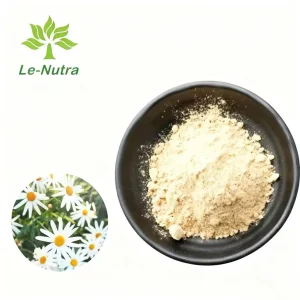
Formulators are moving away from single-ingredient SKUs. The fastest-growing market segments combine hydrolysed marine collagen with synergistic botanical actives—such as Le-Nutra's standardized Chamomile (Apigenin), Saffron (Safranal), and Pomegranate (Ellagic Acid)—creating multifunctional beauty-from-within formulas targeting cellular senescence.
Frequently Asked Questions: B2B Sourcing, Manufacturing & Testing
Authoritative answers to critical scientific, QA, and international trade questions to support your vendor qualification dossier.
What is the specific differentiation between Fish Collagen Peptides and Bovine Collagen Peptides in clinical efficacy?
How does Le-Nutra eliminate the organoleptic fishy odor and bitter peptide off-taste during processing?
What testing methodology is employed to verify true molecular weight distribution?
Can you customize powder physical density for high-speed automatic encapsulation and stick-pack filling?
What quality documents and batch-specific records are provided for customs clearance and vendor audit?
Complementary Bioactive Protein & Phytochemical Portfolio
Standardized plant protein isolates, hydrolysates, cosmetic-grade pure peptides, and pharmaceutical precursors supporting holistic formulation development.