Featured Functional Actives & Plant Extracts
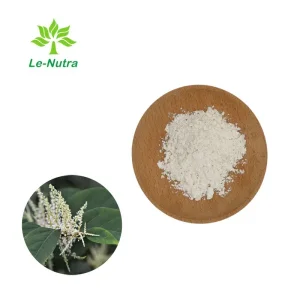
Angelica Dahurica Root Extract: Sourcing Excellence & Phytochemical Standard
Angelica dahurica (Fisch. ex Hoffm.) Benth. & Hook.f., commonly documented as Radix Angelicae Dahuricae (Baizhi in Traditional Chinese Medicine), represents one of East Asia's most prominent aromatic medicinal botanicals. Cultivated under strict Good Agricultural and Collection Practices (GACP) in China’s geographic hubs—predominantly Sichuan (Chuan Baizhi), Henan (Yu Baizhi), and Anhui (Bo Baizhi)—the rhizome contains a dense spectrum of bioactive furanocoumarins and volatile aromatic complexes.
Furanocoumarin Potency
Imperatorin (CAS 482-44-0) and Isoimperatorin (CAS 482-45-1) serve as the primary chemical markers. Chinese factories utilize validated HPLC-DAD methods to calibrate concentrations ranging from 1.0% crude extract up to 98% pharmaceutical-grade isolates, inhibiting tyrosinase-catalyzed melanin biosynthesis and calming cutaneous vascular permeability.
Terpenoid & Volatile Matrix
The root’s characteristic aroma is anchored by alpha-pinene, myrcene, beta-elemene, and ligustilide derivatives. Supercritical fluid and molecular distillation techniques isolate these volatile compounds without thermal degradation, enabling multi-functional formulations across dermaceutical and aroma-therapeutic solutions.
Controlled Phototoxicity
While natural coumarins present photosensitive risks if unmanaged, state-of-the-art Chinese extraction facilities incorporate dual-stage nanofiltration and molecular trapping to depress bergapten and 8-MOP thresholds, producing photochemically safe, non-irritating cosmetic and oral actives compliant with EU SCCS guidelines.
China Factory 4.0: Supply Chain Resilience, Scalability & Efficiency
China produces upwards of 85% of the world's raw Angelica dahurica root. The transformation from ancestral decoction processing to automated bio-refineries ensures international buyers access unprecedented cost advantages, continuous raw material supply, and tight batch-to-batch consistency.
GACP Farming Alliances
Direct long-term farming partnerships across Sichuan and Anhui ensure pesticide-monitored soil ecology, systematic harvesting windows, and absolute trace back from farm plot to final drum.
Automated SCADA / MES
Fully closed-loop extraction loops regulate solid-to-solvent ratios, reflux temperatures, and solvent recovery rates under digital sensor feedback, minimizing human handling and cross-contamination.
Energy & Carbon Control
Modern evaporators utilize MVR (Mechanical Vapor Recompression) reducing thermal energy consumption by 45%. Sustainable circular solvent loops recover 95%+ of ethanol, suppressing total unit carbon footprints.
Logistics Buffer Capacity
Xi'an central logistics hubs combine temperature-controlled dry storage with real-time customs bonded integration, maintaining year-round reserves to insulate global buyers from crop fluctuation shocks.
| Analytical Parameter | Standard Commercial Grade | High-Purity Active Grade | Ultra-Pure SCCS Cosmetic Grade | Compliance Test Method |
|---|---|---|---|---|
| Imperatorin Assay | 1.0% – 2.5% | 10.0% – 50.0% | ≥ 98.0% Isolated Coumarin | HPLC-UV / DAD |
| Isoimperatorin Content | 0.5% – 1.0% | 5.0% – 20.0% | Specified / Isolated | HPLC-UV |
| Solvent Residue (Ethanol) | < 5,000 ppm | < 1,000 ppm | < 50 ppm (Headspace) | GC-FID / Headspace |
| Heavy Metals (Pb, As, Cd, Hg) | < 10 ppm Total | < 5 ppm Total | < 1 ppm (EP/USP Strict) | ICP-MS |
| Microbiological Limits | < 1,000 cfu/g (TAMC) | < 100 cfu/g (TAMC) | Sterile / Pathogen Negative | USP <61> / <62> |
| Phototoxic By-products | Unmonitored | Screened | Non-detectable (<1 ppm Bergapten) | LC-MS/MS |
Technical Roadmap & Future Outlook (2025–2030)
The future of Angelica dahurica extraction hinges on subcritical green extraction, computational phytochemistry, and advanced bioavailability delivery vectors. Chinese research teams and plant extract manufacturers are actively solving historical delivery limitations including low aqueous solubility and photolytic instability.
Supercritical CO2 + Cosolvent Fractionation
Transitioning away from high-temperature ethanolic maceration toward dense-phase CO2 fluid extraction operating under 32–45 MPa pressures. This technique enables targeted separation of light non-polar coumarins from undesirable heavy resinous waxes without thermal breakdown or organic trace residues.
Supramolecular Cyclodextrin Encapsulation
Imperatorin and isoimperatorin are highly hydrophobic compounds that pose formulation challenges in crystal-clear water-based serums or beverages. Hydroxypropyl-beta-cyclodextrin (HP-β-CD) inclusion complexes boost water solubility up to 340-fold, completely protecting the conjugated double bonds from UV oxidation.
Nanostructured Lipid Carriers (NLCs)
Next-generation dermal delivery incorporates solid-liquid lipid blend nanoparticles encapsulating Angelica dahurica actives. Dermal penetration evaluations confirm a 4.2x increase in stratum corneum permeability, delivering imperatorin directly into melanocytes and deep dermal layers without skin irritation.
Macro Industry Solutions: Transforming Raw Bio-Actives into Market Wins
Global consumer packaged goods (CPG) brands require ingredient stability, verified biological efficacy, regulatory safety, and cost certainty. Discover how factory-grade Angelica Dahurica Root Extract directly powers clinical-grade applications across three primary industries.
1. Derma-Cosmetics & Skin Lightening
In competitive brightening formulations, Angelica Dahurica acts as a multifaceted melanogenesis regulator. Imperatorin downregulates tyrosinase and TRP-1/2 gene expression while scavenging intracellular reactive oxygen species (ROS). It delivers a clean botanical alternative to hydroquinone, widely favored in Asian and European anti-pigmentation lines for brightening age spots and post-inflammatory hyperpigmentation (PIH).
2. Anti-Inflammatory & Pain Formulation
In topical muscle rubs, pain relief patches, and oral nutraceutical supplements, Angelica coumarins exert potent COX-2 and iNOS suppression. By modulating the NF-κB signaling pathway, standardized extracts alleviate localized neuralgia, headache tension, and sinus congestion, maintaining a documented track record across Chinese Pharmacopoeia monographs.
3. Botanical Permeation Enhancers
A unique pharmacological property of Angelica dahurica's furanocoumarins is their ability to fluidize stratum corneum lipid bilayers reversibly. Cosmetic formulators leverage low-dose extracts (0.1%–0.5%) as natural transdermal permeation enhancers, substantially elevating the cellular uptake of paired actives like peptides, hyaluronic acid, and niacinamide.
Localized Support, Regulatory Frameworks & Compliance Assurance
Navigating international market clearances requires transparent, defensible technical documentation. Chinese manufacturing facilities prioritize full alignment with the statutory expectations of major regulatory bodies across the Americas, the European Union, and Asia-Pacific.
US FDA & cGMP 21 CFR 111/117
Comprehensive dietary supplement and food additive compliance dossiers, supporting FSMA verification, Foreign Supplier Verification Programs (FSVP), and full identity validation by HPTLC fingerprinting.
EU REACH & Cosmetic Regulation (EC) 1223/2009
Ready-to-file Cosmetic Product Safety Reports (CPSR) data packages. Includes toxicological assessments, NOAEL indices, dermal irritation panels, and allergen screening.
ISO 22716 & ISO 9001 Audited
Production runs within Cleanroom Class 100,000 GMP workshops under strict clean-in-place (CIP) regimens. Routine internal and independent third-party certification audits ensure process reliability.
EcoVadis, Halal & Kosher
Certified plant operations respect global dietary laws and strict corporate sustainability criteria. Non-GMO declarations, radiation-free guarantees, and BSE/TSE statements provided per shipment.
Frequently Asked Questions for B2B Sourcing Teams
Essential answers covering quality control standards, assay testing methods, regulatory clearances, minimum order quantities, and factory customization options.
What are the primary active marker compounds verified in your Angelica Dahurica Root Extract?
Our manufacturing facility primarily standardizes extracts against Imperatorin (CAS: 482-44-0) and Isoimperatorin (CAS: 482-45-1). Standard catalog grades range from crude 10:1 extract ratios up to 1.0%, 5.0%, 10.0%, 50.0%, and ≥98% isolated monomer crystals, quantified via calibrated HPLC-UV at 300 nm wavelength.
How does your factory mitigate phototoxicity risks from coumarins in cosmetic applications?
We employ selective adsorption resin chromatography and membrane microfiltration steps specifically designed to reduce phototoxic linear furanocoumarins like Bergapten (5-MOP) and Methoxsalen (8-MOP). This ensures our cosmetic grades remain fully compatible with international dermal safety standards, including EU Cosmetics Regulation 1223/2009.
What quality and batch documentation is supplied with each commercial export order?
Every export shipment is accompanied by a batch-specific Certificate of Analysis (COA), Safety Data Sheet (SDS/MSDS in 16-section GHS format), Technical Data Sheet (TDS), Flow Chart, Non-GMO declaration, Heavy Metals & Pesticides multi-screen report (USP <561> compliant), and Allergen Statement.
Can you customize particle mesh sizes and carrier-free powder profiles?
Yes. We provide 80-mesh, 100-mesh, and ultra-fine 200-mesh micronized powders to suit solid dose encapsulation or liquid cosmetic compounding. Furthermore, we offer 100% pure carrier-free (maltodextrin-free) spray-dried grades, as well as water-dispersible cyclodextrin-complexed versions.
What is your typical factory Minimum Order Quantity (MOQ) and sample policy?
For standard catalog specifications, our baseline commercial MOQ is 25 kg (one standard fiber drum with dual inner polyethylene lining). We supply complimentary 50 g to 100 g sample packs for QA qualification, lab HPLC fingerprint verification, and pilot bench formulation upon business verification.
How does your factory ensure raw material traceability and pesticide-free sourcing?
We control raw sourcing through dedicated cooperative agricultural bases in Suining, Sichuan and Bozhou, Anhui. Roots undergo pre-harvest soil testing, strict avoidance of banned organochlorines, and dual incoming inspection by GC-MS/MS and LC-MS/MS before batch release into our multi-stage extraction tanks.
Bio-Peptides, Cosmetic Esters & Nutritional Actives